Posts Tagged ‘Togo’

« Previous Entries Next Entries »

Apr 30
No Gravatar

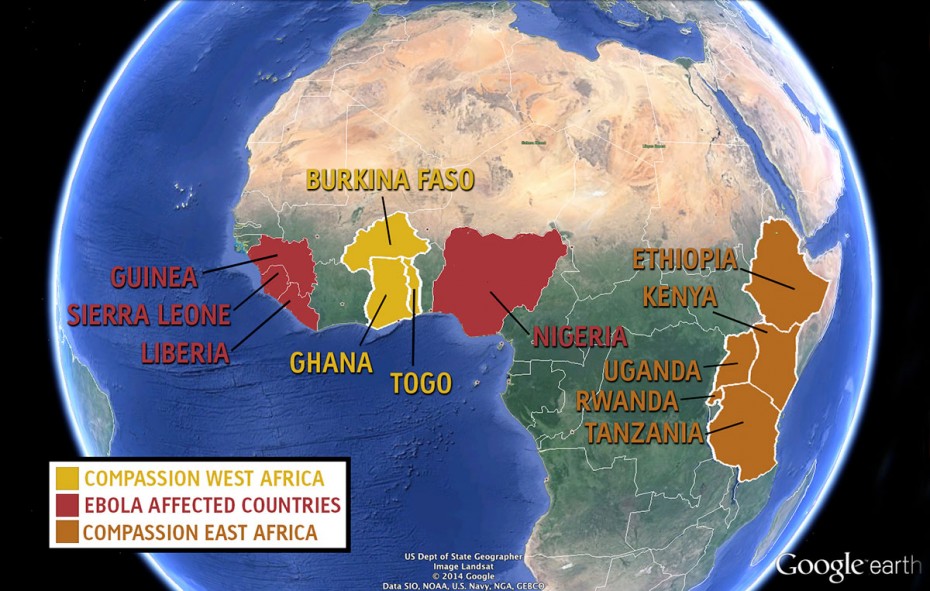
Over on another blog post – Where Do You Sponsor a Child? – several sponsors have been exchanging maps of the countries where we work; maps that list the child development center numbers and give a rough approximation of where the centers are located in relation to one another.

You can now find all of those maps in our Flickr account.

« Previous Entries Next Entries »

Feb 13
No Gravatar

Remember when we registered our first child in Togo? That was about five months ago. Would you like to know how Compassion Togo is doing now?

Good! We have that for you!

Visit Togo’s news page and read what the Acting Country Director has to say about Compassion’s impact in Togo thus far. We think you’ll be encouraged :)

Also, if you would like to stay updated on what is happening in our newest country, you can subscribe to the Togo feed.


Excuse us! Is that you? Are you still here? Move along now, go read the update!

« Previous Entries Next Entries »

Dec 3
No Gravatar

This is David. He was the first registered child in Togo.

david-togo-free-bible

david-togo-free-bible-two

And this is his sister, Gracia. She was the second child registered by Compassion Togo.

gracia-togo-free-bible

gracia-togo-free-bible-one

They don’t have sponsors yet. And neither do these Togolese children.

If you:

  • sponsor a child from Togo between now and December 31
  • AND you sign up for automatic credit card payments
  • we’ll send* you a really keen pocket-sized, leather NIV Bible with the Compassion logo on it

If you want to sponsor David or Gracia, you’ll have to talk to Compassion Australia about that. Give ‘em a call.

These Togolese children are also available for sponsorship through Compassion Australia. They’d love sponsors too.


*Please allow two to three weeks for your Bible to be delivered. The free Bible is available to children sponsored through Compassion U.S. only.

« Previous Entries Next Entries »

Nov 21
No Gravatar

Story by Delanyo Tenge, Compassion Togo program communications manager, and Barb Liggett, Global Strategy Office intern


September 17, 2008 was the day the staff of Compassion Togo (CIT) had prepared fervently for, and the excitement had reached its peak. As Compassion’s newest country, the staff began registering children in Compassion Togo’s first child development center.

At MESA (Ministères Evangeliques pour le Salut des Armes), the partner church for Togo’s first Compassion children, Pastor Happy and his entire congregation are enthusiastically helping CIT become deeply rooted in Togo.

“We want to equip the local churches so they can minister to their community holistically and win them to Christ. We want to help the church turn their community into a place of hope for the future,” says CIT Country Director Mawuna Lawson.

The first child registered in Togo was David. The second was his sister, Gracia. When asked what he hopes to be when he grows up, the quiet David whispers “a carpenter.”

Even though it was the first registration, errors and omissions were few. CIT has set a goal to register more than 2,000 children the first year. There are currently 10 partner churches and six staff members in the county. Compassion Togo faces a steep road, but the hard work already done and the passion displayed in the ministry make it clear that much should be expected from the new Compassion country.

Another pastor shares his joy,

“We have been asking God how better we can help our children grow up and become good Christians and responsible adults, occupying good positions in our country; it has always been a burden on our heart. So when CIT came, we knew they were God sent, we didn’t need to ask how, when or why they came, all we needed to do was to thank God and to embrace the task he had laid ahead for us to do together with CIT.”

togo-registered-child

Photo by Delanyo Tenge

« Previous Entries Next Entries »

Jun 26
No Gravatar

This is part four in our four part series – The Case for Compassion Togo

Driving through the streets of Lome, Togo, scenes unfold that are far too common in sub-Saharan Africa. Individuals ranging from very young to very old sit and stand at the side of the road, hoping to sell baked goods or sweets or small kitchen items or a myriad of other trinkets to passers-by. The roads are bad and get worse as you depart the busiest streets. Many of the buildings — showing signs that they were beautiful at one time — appear to have been abandoned long ago but are, in fact, current offices and businesses.

In a place where even those with “stable” civil jobs have no guarantee of being paid, the overarching atmosphere is one of apathy brought on by too many years of being resigned to the situation. But in the midst of all this, there are people who refuse to accept the current circumstances, who reject the idea that there is nothing to be done.

Take, for example, Pastor Happy and his Pentecostal congregation located in the heart of Lome. Pastor Happy possesses a smile and exudes an optimism that confirm in every way the appropriateness of his name. Though the congregation is large, it is also poor and so the sanctuary is a work-in-progress, complete with rustic wooden scaffolding and tarps over areas that don’t yet have the protection of a roof.

togo-pastor-happy

Pastor Happy explains that his church recognized a few years ago that they must “have a vision for helping those in need — and addressing more than just their spiritual needs.” What the congregation lacks in financial resources it has made up for in passion, creativity and dedication. When they outgrew the one room they had available for children’s Sunday school, rather than waiting to come up with funds or space for another building project, Pastor Happy simply went to the school located next door and asked if they could use the classrooms on the weekend. The school agreed.

In addition to the Bible classes, the church now houses a medical clinic, provides food, clothing, school supplies and more to those with the greatest need in their community and shows films with a positive message after school so children have a safe place to go. All this is accomplished largely through the donation of goods, time and services of church members with a vision. The church would like to be able to do more, but in the meantime has decided to be faithful with the opportunities that present themselves.

Among those who have been positively impacted by the church’s ministry is the family of a couple called Mesa and Ama. Even before one has an opportunity to speak with their six inspiring children, this couple is exceptional. In a country where pastor after pastor estimates that 80 to 90 percent of the families in their communities are headed by single mothers, that Mesa has stayed faithful to his wife and family is a notable fact.

Mesa is a carpenter and Ama sells secondhand clothing. Their two daughters and four sons join in, but the family has also made sure that all the children stay in school.

togo-mesa

Awolfa, 19, is the right arm of her mother in caring for the rest of the family but also has been able to complete secondary school and is currently attending classes to become a tailor. Her 16-year-old brother Francis and 12-year-old brother Felix both dream of being doctors, and 15-year-old Edem hopes to become a pastor.

Though they struggle to meet all their current needs, this family has not lost the belief that the future can be different. It is tempting to consider how far such a motivated group might go with the added support of Compassion’s child development program, and it is in the faces of the two youngest, seven-year-old David and his four-year-old sister, Gracia, that one sees the possibility of this future.

David is quiet and contemplative and Gracia is his exact opposite. When asked what he hopes to be when he grows up, he whispers “a carpenter.” Gracia does not wait to be asked, but announces loudly, “I will be a seamstress like Awolfa.”

By starting a work in Togo, Compassion has the opportunity to minister to the Davids as well as the Gracias, along with the tens of thousands of children whose lives are even more unstable and uncertain because they have only one parent or have no one to advocate for them regarding the importance of staying in school. It’s an opportunity to support and encourage those parents like Mesa and Ama, who by some miracle have not lost their hope and vision for the future — and to bring back hope to those who have begun to despair.


Story and photos by Phoebe Rogers

« Previous Entries Next Entries »

Jun 25
No Gravatar

This is part three in our four part series – The Case for Compassion Togo

Christianity in Togo dates back to the mid-1800s when the Methodist and Presbyterian denominations organized churches in the country. They were followed by the Catholic Church about 40 years later and today are joined by churches affiliated with the Assemblies of God, Pentecostals, Baptists, Lutherans and many other denominations. According to available statistics, Togo is 29 percent Christian.

In recent decades, several “umbrella” organizations have formed that include church leaders from the various denominations who desire to work together. In the past, there has been little-to-no collaboration among the denominations, but leaders are rising up who wish to bring unity and strength to the Church so that they might in turn more effectively evangelize and influence their country.

Many of these church leaders share anecdotal evidence that the church is currently growing at a more rapid rate than in past times. Many have also identified their ministry to children as a universally weak area among the churches, and at the same time, recognize a need for a greater focus and strength of purpose if they are to influence these young people who are future of their country.

togo-church

Increasingly, churches in poor areas (which are by far the majority of churches in the country) are recognizing that if they are to be relevant within their communities, they must address more than only the spiritual state of the people. Some churches simply take up offerings and use the funds to try to meet the various needs that come to their attention. Others are more structured, asking people to bring extra clothing, shoes, food and school supplies they might have so that they can be redistributed to those with the most severe need.

A church in Lome shows films with a positive message after school to give children a place to go so they won’t loiter in the streets. Thanks to the vision of a retired doctor, this same church also runs a clinic where they not only treat those who need medical attention in their own community but also train volunteers so that they can go out and minister through medicine in nearby rural communities.

Everywhere there are children, so many children, most coming from single-parent homes and many of whom have little adult influence on their lives. Many churches desire to find ways to improve and expand their children’s ministries, want to attempt to provide more structure and even have begun looking for ways to train those who work with the children so they might provide better guidance.

There is anecdotal evidence that these ministries are positively impacting these churches’ ability to witness to and impact their communities. This may be seen both in the way the church leaders are received and welcomed when they visit homes in the communities, and also in the comfort level that neighbors — and especially the children — feel to come to the church.

TOMORROW: Putting Faces to the Statistics


Story and photo by Phoebe Rogers

« Previous Entries Next Entries »

Jun 24
No Gravatar

In addition to the expectation and excitement of registering our first child in Togo later this year, I’m very excited to say that two weeks ago our Board of Directors unanimously approved plans to begin work in Sri Lanka.

Of course, there is still much preparation that needs to be done to launch this new country, but we’ve proposed a timeline that includes registering the first children in Sri Lanka during the summer of 2009.

Please pray with us that this will be a smooth process, that doors will open as needed and that many little lives in Sri Lanka will be changed for eternity.

« Previous Entries Next Entries »