Posts Tagged ‘Haiti’

« Previous Entries Next Entries »

Jan 20
No Gravatar

Children in poverty Children in poverty … through the eyes of Eric Chapman, one of our friends in Flickr.

If you have difficulty viewing the slide show here, you can also check it out in Eric’s photostream.

Upload your photos to our Flickr group. Show us how you see children in poverty.

« Previous Entries Next Entries »

Jan 12
No Gravatar

Port-au-Prince The first thing you notice when you wake up in Port-au-Prince is the smoke. Your eyes sting, and it feels as though you’ve had a smoky cloth held over your mouth all night from the Haitians’ cooking fires. I half expect to wake up next to a campfire in my tent, not in a major city.

The streets of Port-au-Prince are a zigzagging labyrinth that all look the same to me, and I can’t understand how everyone isn’t permanently lost. The streets are steep like San Francisco, and so potholed that you practically have to have a truck or SUV to buck up and down and over the broken cobblestones.

Women in tank tops carry baskets of fruit on their heads, while others squat roadside frying plantains for passers-by.

Tap taps, the main transportation through the city, spill over with thin men in suits on their way to work. The tap taps are a chaos of color, pickup trucks painted in fuchsia and purple and green with pictures of famous singers and Jesus on them.

As our truck sits in traffic, a woman with blank eyes taps on the window with her hand held out.      

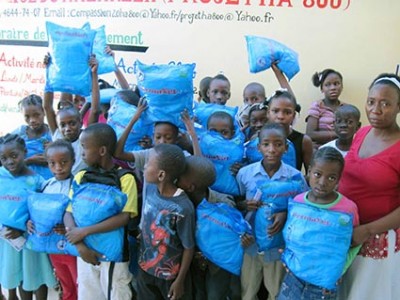
We arrive in front of the white-barred gate of a Compassion-assisted child development center, that opens up to a wide courtyard filled with children playing basketball and running about.

The children spot my camera right away and timidly tap me on the shoulder, hoping to have their picture taken so they can see their faces on the screen. They smile and giggle until I raise the camera, when they suddenly stand up straight and compose themselves seriously for their photo shoot.

The courtyard is ringed by classes, and we smell cookies baking in the cooking class filled with teenage girls. They give us a plate to take home with us.

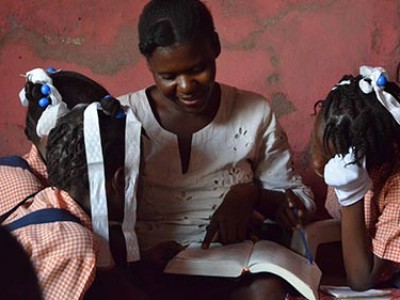
We poke our heads in various classes where some are learning sewing, some painting, and some are studying the Bible.

In the class of 3- to 5-year-olds, we greet the class, “Como ca va?” And 30 little voices shout back in unison: “Ca va bien, merci! Et vous?!”

I speak to the teacher of the painting class, who learned to paint in that very project. Now he makes occasional money selling his paintings on the street. He is meek and quiet and asks that I’ll pray he can afford Bible school so he can become a pastor.

I talk to the project accountant, a tall, well-spoken man who asks for the prayer of the sponsors as he and the other project workers serve the children.

After disrupting several classes and giving an impromptu geography lesson, we leave with our plate of cookies. We bump back up and down the Port-au-Prince streets, and I’m frankly relieved to pull safely up to our clean hotel away from the noise and smells of the streets. 

We have dinner at the hotel, looking down over the pool and tennis courts, surrounded by lush green overgrowth. I ask my Haitian friend if he likes it here, in Port-au-Prince, where he has grown up. He shakes his head no. Although it is home, he would rather be elsewhere, like the millions of the Haitian diaspora.  

And yet, he stays. I’ve grown to admire these people who believe in and love their country, even when it would seem so tempting to desert in a situation so hard. Yet each day, they get up and choose to try to be a part of changing their country by serving the children and giving them hope for a different future.

« Previous Entries Next Entries »

Sep 25
No Gravatar

“Compassion Haiti is a reference and a light house for the Haitian population.” — Guilbaud Saint-Cyr, country director for Compassion Haiti

During the 40 years of our ministry in Haiti, thousands of young people have committed themselves to Christ. Many of those young men and women have won their parents and many other people from their communities to Christ by their commitments and Christian attitudes.

Compassion started its ministry in Haiti in 1968. At that time, we worked directly through the missionaries established in the country while maintaining no country office or local staff. But through the years, our structure has changed as more and more children have been registered in our programs.

Compassion Haiti has grown through the years in all levels.

  • From 25 employees in the 1990s, it has now reached 69 staff.
  • God has blessed the ministry with a new building adjacent to the old one. That new rented building accommodates program implementation. The office has rooms for more years of fast growth.
  • In order to better serve the projects and partners, Compassion Haiti has hired 12 field-based partnership facilitators from fiscal year 2007 up to now. The presence of the partnership facilitators in the field contributes a great deal to child development center growth and empowerment improvement.

Compassion trains and equips local evangelical church partners to administer a broad range of child development activities from child survival to child sponsorship and leadership development.

Our Leadership Development Program (LDP), launched during the past 12 years, is having incredible effects on the Haitian society.

  • 72 percent of our graduates are employed in key administrative positions both in the public and private sectors, in comparison to the country-level employment statistics of 20 percent

Among those is Abel, a former LDP student, who grew up in a slum but doesn’t live in one anymore. Abel is 27 years old and a university graduate in business management. Among the five children in his family, Abel is the only who has a university degree. The encounter of Abel with Compassion has changed his and his family life for ever.

“Like many other young men, I would probably be a gang member if it were not for the Compassion program in the community. People treat me with much respect, and they are also proud of me. I want to take advantage of that opportunity to make an impact in the community.”

The level of education provided by Compassion has made a great difference in the academic performance in the whole country:

The table below shows a comparison between national and sponsored children success rate in state exams.

40th-anniversary-Haiti-success-rate-table

Many of those who have emerged from the darkness of poverty and ignorance are now serving their communities as strong and committed Christian leaders.

The children whose lives are being transformed through this ministry will become the future leaders of Haiti to, in turn, transform our country.

Haiti children

The 40 years of Compassion in Haiti have been a success — but not without challenges.

“My greatest satisfaction is the fact that Compassion has given me the opportunity to see some of my dreams accomplished. I can see the outcomes of my initiatives in the lives of children, communities and churches as I am surrounded by qualified and committed staff to bring about the changes.” – Guilbaud Saint-Cyr, country director for Compassion Haiti

Perspectives for the 10 years to come

Guilbaud intends to celebrate the 50th anniversary of Compassion in 2018 with some major accomplishments:

  • increasing our development programs from 227 to 300
  • facilitating the growth of our Leadership Development Program from 80 students to 200
  • bringing total staff to 100
  • 100 percent of our children will be vaccinated
  • 50 percent of our child development programs will have access to potable water

« Previous Entries Next Entries »

Sep 22
No Gravatar

Remember when I told you about my new job? I’ve been doing it for several months now and so I feel like I’ve gotten a pretty good grip on things. Well … as good a grip as one can have on a job that depends entirely on world events. And oh my word, the world has been eventful lately, hasn’t it?

One of the first things I do each day when I get to work is open up six world news websites. I browse each site for headlines about our 24 field countries to get an idea of what kind of crises I might be reporting that week.

When I’m reading through the headlines, I sometimes get the surreal feeling that I’m getting a tiny glimpse into God’s view of this world. For a few moments, my perspective shifts from my self-centered, ego-centric worldview to one where we are simply a severely broken and hurting creation in desperate need of redemption.

Right now in the United States, we are practically smothered with political ads and news reports about the faltering economy, but really these “issues” pale in comparison to what’s going on in the rest of the world.

Besides the global food crisis (which you’ve probably heard about by now) here’s an idea of what our staff and children on the other side of the globe are currently facing:

  • Thailand and Bolivia are both dealing with political unrest and violent protests of the current government.
  • Haiti and the Dominican Republic are struggling to recover from four successive hurricanes.
  • The Philippines has faced violent political conflict.
  • India is in the midst of serious and deadly religious conflicts between Hindus and Christians.
  • Burkina Faso has recently had heavy rains and flooding throughout the country.
  • Bangladesh is dealing with continual flooding.

I’m sure there will be more bullet points to add tomorrow. It’s difficult to read the same kinds of headlines day after day, reporting over and over the non-stop fighting, corruption and scandal happening in every corner of the globe. But more than depressing me, it makes me angry. I know who is ultimately responsible for the evil in this world, and I hate him. But I also know it will end someday, and I know how it will end.

And this is what keeps me going.

« Previous Entries Next Entries »

Sep 7
No Gravatar

As you read this post, keep in mind what Haiti has recently experienced: Tropical Storm Fay, Hurricane Gustav and Tropical Storm Hanna. Plus, Hurricane Ike is bringing more misery to the island as it moves past Haiti this weekend.

Government officials have declared a state of emergency and appealed to the international community for help because of the devastation the first three storms have wreaked.

And there are still two months left in the 2008 hurricane season.

haiti-flooding

Donate to the Haiti Hurricane Response Fund to help with Haiti’s substantial relief and recovery efforts.


I thought I saw devastation and despair in this year’s Iowa floods. And I did. But it got me thinking, “What is life like for a Compassion child living in a country affected by regular flooding?”

Have you ever considered how a child in a developing nation is affected by a natural disaster?

Let me tell you a little bit about flooding in one of our Compassion countries — Bangladesh.

  • Thirty to seventy percent of the country floods each year due to monsoon rains and tropical storms. (1)
  • The number one cause of death of children in Bangladesh is drowning. During heavy flooding, parents tie small children to rooftops with ropes or chains to keep them from slipping into the water while they go in search of food and aid. (2) (3)
  • Farmers can easily lose an entire year’s income in a single flood. Two-thirds of Bangladeshis rely directly or indirectly on rice farming for their living. When there are no rice crops, there is no living. (4) (5)
  • Families facing starvation often turn to money lenders called Mohajon for loans. The families are charged interest rates of up to 200 percent per year. When they cannot repay the loan, they lose the remainder of their possessions or are forced to work for free. Some families sell their children in exchange for food or money. (6) (7)
  • Floodwater mixes with sewage that seeps out of latrines or sewers. With no other potable water, families have no choice but to use this water for drinking and boiling vegetables. Children in particular are at risk for diarrhea, respiratory diseases, typhoid and scabies. Children who are fortunate enough to be taken to a clinic may recover only to be sent back to the same conditions. Most don’t recover at all. (8) (9)

As a Compassion sponsor, I see a multitude of ways that a Compassion child development center could step in and save a family during such a crisis. Each center is a literal safety net for a child in times of flooding.

And think of what a family gift from a sponsor can do!

A Bangladeshi family could invest in flood-resistant rice, floating gardens, flood-resistant housing – all recent innovations denied to Bangladeshis living in poverty. A generous family gift could make a life-changing, life-saving purchase possible.

If you are thinking of sponsoring another child, (and I hope you are!), please take a look at the children of Bangladesh or other countries that face flooding each and every year.

Also, I would SO appreciate comments from those of you who have been to countries where flooding regularly occurs (e.g., Haiti, Mexico, Indonesia, Honduras and of course, Bangladesh) and seen the aftermath firsthand.

Perhaps you took a sponsor tour and can speak to the work Compassion is doing. Or perhaps you have sponsored children who have shared their experiences with you.

You are the mouthpiece for these people. Please speak up and tell us what you know.

How many disasters occur each year that we never hear about — that fly under our radar here in the U.S.?

Help educate us.

(more…)

« Previous Entries Next Entries »

Sep 3
No Gravatar

Thank you to all of you who submitted questions for Ephraim, my esteemed colleague in Haiti! As you all were curious cats and asked more than 10 questions, I picked 10 that I thought were representative of all the questions.

As I mentioned before, Ephraim has got a lot of perseverance. Check out the Compassion Haiti staff photo from 15 years ago. He’s one of only two staff members still remaining.  

Compassion Haiti staff

1. What are the great things about Haiti that you want us to know about? Tell us something special about the people of your country, like a particular strength of them. (Lisa Miles

Haiti is economically considered one of the poorest countries of this hemisphere. However, this country is also unique in its natural and culturally diverse resources.

The Haitian is born with the ability to make the most beautiful artwork in the world. No matter the social class he is issued, the Haitian is capable to transform the simplest raw materials into the most enjoyable items. The Haitian paintings are of the greatest imagination, along with our sculpture in wood, steel, or stone.

Although most of its natural resources are unexploited, Haiti is one of the countries with the most beautiful beaches in the Caribbean.

Besides all of its artistic ability, most of the educated Haitians speak up to four languages: Creole (native language), French (official), English, and Spanish with proficiency. 

2. I would love to hear your favorite story of children in your programs whose lives were really turned around by being part of Compassion. (Amy)

There are so many success stories that I could share but there this one that is unique to me. It is about a boy named Zaccalot. (more…)

« Previous Entries Next Entries »

Aug 18
No Gravatar

Okay, everyone. Limber up those fingers. It’s time for the next round of Ask the Field. It’s time for you to ask questions of two of my fabulous coworkers, Ephraim Lindor of Haiti and Roberto Medrano of El Salvador.

EphraimEphraim has been working with Compassion Haiti for 22 years. (Talk about perseverance!)

He first worked for Compassion as a translator, and he is now the field communications supervisor for Haiti. His daily work includes interviewing Compassion beneficiaries and writing stories about their success.

Ephraim is always smiling, and he loves watermelon. Besides all the work he does for Compassion, he’s a pastor at his local church, a loving father of a 21-year-old woman and a 15-year-old boy, and a loving husband of 23 years.

roberto-dennisRoberto has been working with Compassion El Salvador for 6 years. He first worked for Compassion as field communications specialist and now he is the communications and tours specialist for Central America and the Caribbean, which means he is in charge of training and supporting all Compassion countries in that region for communications and tours. (He’s a busy guy!)

Roberto is the youth pastor of his church, and although he is just 30 years old, he has been preaching for more than 26 years. He was a child preacher, and that is one of the reasons why he loves Compassion’s ministry — he has witnessed first hand the impact of God’s Word when you are a child. He is crazily in love with his beautiful wife, Yolanda, an ORU graduate that fully supports him in working on behalf of children.

So now it’s your turn to ask away! You know the drill by now — I’ll choose 10 of your questions for them to answer.

« Previous Entries Next Entries »